


The sxy manuscript has been rejected! This was not what we expected, because it had been 'provisionally accepted', with the request that we do toeprinting or similar analyses to confirm our speculations that the secondary structure of sxy mRNA interferes with translation.
We didn't do the requested toeprinting, but instead used in vitro translation assays to confirm our speculations. We were a bit concerned that the editor/reviewers might not see these as an adequate substitute, but that turned out to not be a problem. But a combination of bad luck, bad judgement and bad mood let to it being rejected as not sufficiently improved for publication.
We still think this is an excellent piece of science, so we're going to instead submit it to another journal that's just as good, if not better. We're first giving the manuscript one more quick polish, taking into account all the reasonable and unreasonable comments from referees and making sure that all our explanations are as clear as possible. This should be done within the next couple of days. The new journal has a very fast turn-around time, so we'll know the outcome soon.
Field of Science
-
-
Change of address1 year ago in Variety of Life
-
Change of address1 year ago in Catalogue of Organisms
-
-
Earth Day: Pogo and our responsibility1 year ago in Doc Madhattan
Showing posts with label Sxy. Show all posts
Showing posts with label Sxy. Show all posts
What's UP, Sxy?

One of the grad students has been doing experiments to clarify how the transcriptional activator protein Sxy turns on genes that have its recognition sequence, the "CRP-S" site. He's given me a draft of a paper he's writing about this work.
Sxy works by interacting with another transcriptional activator protein called CRP. CRP's job is to bind to DNA at CRP sites and, by bending the DNA, help RNA polymerase start making RNA. CRP-S sites are much harder to bend than normal "CRP-N" sites, and we have been thinking that Sxy acts by helping CRP to bind (if it can't bend the DNA it lets go).
But several pieces of his data tell us that binding isn't enough. A protein from E. coli (we work mostly in another bacterium, Haemophilus influenzae) binds CRP-S sites fairly strongly in the test tube, but when it's in H. influenzae cells it can't turn the CRP-S genes on without Sxy's help. And changing the CRP-S sequence so H. influenzae's CRP can bind it without Sxy in the test tube doesn't enable CRP to turn the gene on in cells without Sxy's help.
So the grad student is suggesting that Sxy may also affect how RNA polymerase interacts with the DNA. RNA polymerase binds to DNA more effectively if its 'tail' makes contact with an AT-rich sequence called the "UP" sequence. Many genes have an UP sequence, and at normal CRP-N sites CRP is thought to help RNA polymerase's tail bind to it.
He's found that the genes with CRP-S promoters have what look like three precisely-spaced UP sequences beside their CRP-S sites, and in his draft paper he proposes that Sxy acts partly by helping RNA polymerase make contact with these sites. We could test this by changing these sequences to not fit the UP consensus, and seeing if this makes the promoter unable to be activated by Sxy.
This work doesn't address the question of whether Sxy does help CRP bend the DNA. But we won't be able to address this until we have conditions where purified CRP and Sxy both interact. Right now we have the CRP but not the Sxy - it's a very difficult protein to work with.
Sxy works by interacting with another transcriptional activator protein called CRP. CRP's job is to bind to DNA at CRP sites and, by bending the DNA, help RNA polymerase start making RNA. CRP-S sites are much harder to bend than normal "CRP-N" sites, and we have been thinking that Sxy acts by helping CRP to bind (if it can't bend the DNA it lets go).
But several pieces of his data tell us that binding isn't enough. A protein from E. coli (we work mostly in another bacterium, Haemophilus influenzae) binds CRP-S sites fairly strongly in the test tube, but when it's in H. influenzae cells it can't turn the CRP-S genes on without Sxy's help. And changing the CRP-S sequence so H. influenzae's CRP can bind it without Sxy in the test tube doesn't enable CRP to turn the gene on in cells without Sxy's help.
So the grad student is suggesting that Sxy may also affect how RNA polymerase interacts with the DNA. RNA polymerase binds to DNA more effectively if its 'tail' makes contact with an AT-rich sequence called the "UP" sequence. Many genes have an UP sequence, and at normal CRP-N sites CRP is thought to help RNA polymerase's tail bind to it.
He's found that the genes with CRP-S promoters have what look like three precisely-spaced UP sequences beside their CRP-S sites, and in his draft paper he proposes that Sxy acts partly by helping RNA polymerase make contact with these sites. We could test this by changing these sequences to not fit the UP consensus, and seeing if this makes the promoter unable to be activated by Sxy.
This work doesn't address the question of whether Sxy does help CRP bend the DNA. But we won't be able to address this until we have conditions where purified CRP and Sxy both interact. Right now we have the CRP but not the Sxy - it's a very difficult protein to work with.
A provocative sxy result?
Provocative in the sense that it may require that we do something.
A few days ago, in sxy continued I wrote
One possible explanation for the discrepancy between Sxy protein and transformation frequency is that the sxy-6 mutant could have some other genetic change that we're not aware of, that reduces its ability to take up DNA. We can test this by resequencing its sxy gene to check if other mutations are present, and by doing either of two genetic tests. First, we could use transformation to move its sxy gene into a 'clean' genetic background and see if the transformation frequency stays the same. Second, we could move a wildtype sxy gene into it (again by transformation) and see if its transformation frequency becomes wildtype. Either test may be a pain to do because we can't directly select for the desired recombinants, but have to rely on selecting for a linked antibiotic resistance and then checking the genotype by sequencing.
So before doing any of these I'll carefully recheck the PhD thesis of the student who originally made the mutant and studied its properties. If she made and tested a lacZ fusion of this mutant, her results may clarify things.
A few days ago, in sxy continued I wrote
8. The sxy-6 mutant isn't just not hypercompetent, it's much less competent than wildtype cells (10-fold to 500-fold, depending on the assay conditions), even though it is predicted to have the same number of base pairs when folded. This was especially surprising because its mutations replace a strong G:C basepair with a weaker A:T basepair. This may be telling us that in wildtype mRNA the G and C bases interact with bases at other positions as well as with each other, and that these unknown interactions enhance expression of sxy.Now one of the lab people has checked the amount of Sxy protein in this mutant, and found that in rich medium there is a little more than wildtype, as we would have originally expected, not less than wildtype as predicted by its less-than-wildtype transformation frequency.
One possible explanation for the discrepancy between Sxy protein and transformation frequency is that the sxy-6 mutant could have some other genetic change that we're not aware of, that reduces its ability to take up DNA. We can test this by resequencing its sxy gene to check if other mutations are present, and by doing either of two genetic tests. First, we could use transformation to move its sxy gene into a 'clean' genetic background and see if the transformation frequency stays the same. Second, we could move a wildtype sxy gene into it (again by transformation) and see if its transformation frequency becomes wildtype. Either test may be a pain to do because we can't directly select for the desired recombinants, but have to rely on selecting for a linked antibiotic resistance and then checking the genotype by sequencing.
So before doing any of these I'll carefully recheck the PhD thesis of the student who originally made the mutant and studied its properties. If she made and tested a lacZ fusion of this mutant, her results may clarify things.
Progress on the sxy manuscript
I've been working on the sxy manuscript, clarifying/rewriting the text and improving the figures. I'm not yet all the way through the Results but it's looking a lot better.
The Introduction wasn't too bad anyway, but now it flows better and explains the issues in a more logical order. It's also 65 words shorter, mostly because I cut out some repetition and tightened the sentences.
The Results section is a lot better now. I polished Figure 2, which shows the structure of the sxy gene's 5' end, and now point out that this untranslated region is unusually long. The correlation between Sxy protein and competence is stated rather than just being implied, and backed up with Figure 4. We have a beautiful new version of Figure 5, with all the bands clearly visible, but the text describing these results still needs work. The description of the compensatory mutation work is clearer.
I came up with a 'spin' that turns a discrepancy into a result: RNase analysis shows little difference between mutant and wild-type sxy structures, but the phenotypes are very different. I now say this means that the structure is stable in vitro but labile in vivo, probably due to dynamic effects while the mRNA is being synthesized.
My explanation of the fusions of sxy to lacZ are now much clearer, mainly because my many attempts to really understand this data finally paid off. I've inverted the order in which we discuss the normal (long) and stem-free (short) fusions. The short ones were created as a bit of an afterthought (no, that's probably unfair to the grad student who did this - these fusions we something she thought up herself, and I don't know when). Anyway, I realized that we should consider them first, and then contrast them with the fusions that have the normal structure. I think it's much easier to think about this way. And my new clarity also produced a newly-clear figure, with simple schematic drawings of the fusion structures.
And then my brain shut down for the day.
The Introduction wasn't too bad anyway, but now it flows better and explains the issues in a more logical order. It's also 65 words shorter, mostly because I cut out some repetition and tightened the sentences.
The Results section is a lot better now. I polished Figure 2, which shows the structure of the sxy gene's 5' end, and now point out that this untranslated region is unusually long. The correlation between Sxy protein and competence is stated rather than just being implied, and backed up with Figure 4. We have a beautiful new version of Figure 5, with all the bands clearly visible, but the text describing these results still needs work. The description of the compensatory mutation work is clearer.
I came up with a 'spin' that turns a discrepancy into a result: RNase analysis shows little difference between mutant and wild-type sxy structures, but the phenotypes are very different. I now say this means that the structure is stable in vitro but labile in vivo, probably due to dynamic effects while the mRNA is being synthesized.
My explanation of the fusions of sxy to lacZ are now much clearer, mainly because my many attempts to really understand this data finally paid off. I've inverted the order in which we discuss the normal (long) and stem-free (short) fusions. The short ones were created as a bit of an afterthought (no, that's probably unfair to the grad student who did this - these fusions we something she thought up herself, and I don't know when). Anyway, I realized that we should consider them first, and then contrast them with the fusions that have the normal structure. I think it's much easier to think about this way. And my new clarity also produced a newly-clear figure, with simple schematic drawings of the fusion structures.
And then my brain shut down for the day.
Details of RNA folding predictions

I've been checking the predictions that the RNA-folding program mfold makes about our sxy mRNAs, this time using a feature that colours each position according to how 'well-determined' its pairing assignment is, as shown in the first figure. Here for example the unpaired nucleotide at position 20 is coloured red, meaning that Mfold is quite confident that it is unpaired (a "P-num" score of 0 or 1). Similarly, the paired nucleotide at position 21 is also coloured red to indicate that Mfold is quite confident that it is paired. Many of the nucleotides in stem 3 (positions 61-91) are coloured blue or black, to indicate less confidence (P-num scores of 2 and 3 respectively).
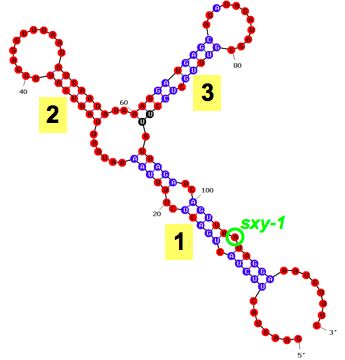 It's important to remember that the colour doesn't indicate how strong the pairing is, but how good the evidence is (either for or against pairing).
The second folded molecule is the mutant sxy-1 RNA. The little one-base bubble at the bottom of stem 1 is caused by the mutation. More notable is that most of the nucleotides in stem 1 are now coloured blue rather than red. This means that changing one base from a G to an A has decreased Mfold's confidence in all the base paired positions in the stem. This is consistent with what our RNase digestions show - the one-base sxy-1 change decreases the proportion of molecules that are base paired at all the positions in stem 1, not just at the site of the mutation.
Sxy continued
7. The reduced competence caused by the compensatory mutations in the sxy-6 strain proves that the sxy-1 and sxy-3 mutations cause hypercompetence by decreasing the number of base pairs in folded sxy mRNA. To confirm the effect, and to see how strongly the folding can inhibit sxy expression, we made a mutant with two extra base pairs (sxy-7). As predicted, it is even less competent - in fact it can't be transformed at all (Fig. 6A).
8. The sxy-6 mutant isn't just not hypercompetent, it's much less competent than wildtype cells (10-fold to 500-fold, depending on the assay conditions), even though it is predicted to have the same number of base pairs when folded. This was especially surprising because its mutations replace a strong G:C basepair with a weaker A:T basepair. This may be telling us that in wildtype mRNA the G and C bases interact with bases at other positions as well as with each other, and that these unknown interactions enhance expression of sxy.
9. We also directly checked the amounts of Sxy protein in the sxy-6 and sxy-7 mutants; it's much less than in the parent mutants and in wildtype cells (Fig. 6B). I don't have the draft version of Fig. 6B yet, although the data has been collected.
10. We don't know how the mRNA base pairing prevents sxy expression, although we are considering several possibilities, all involving effects either on the amount of sxy mRNA in the cell, or on the ability of the mRNA to be translated into protein. To distinguish between these, we examined the amounts of sxy mRNA in wildtype and mutant cells under various culture conditions. If folding reduces Sxy protein by reducing the amount of mRNA, then the mutant cells should have amounts of sxy mRNA proportional to their amounts of Sxy protein. If folding acts only by preventing translation, then the mutants should all have the same amount of sxy mRNA as wildtype cells.
The results are intermediate. The mutants contain less sxy mRNA than the wildtype cells, but they contain more mRNA than we would expect from their reduction in Sxy protein (Fig. 7; I don't have all of the final data for this figure). This means that the folding must limit both the amount of sxy mRNA and its ability to be translated into protein.
11. This conclusion is supported by data from gene fusions that put the E. coli lacZ gene under control of sxy mRNA. One kind of fusion ("operon fusion") tells us about effects of sxy amount and on folding on mRNA amount; the other ("protein fusion") tells us about the combined effects on mRNAmRNA translatability. [I hope I've got this right - I find it very hard to keep these effects straight.] We (i.e. a former PhD student) constructed two pairs of fusions. In one pair, both fusions (protein and operon) join lacZ gene (to a downstream position in the wildtype sxycodon 89), meaning that in both the mRNA can fold normally. In the other pair, both fusions join lacZ to a position further upstream (codon 11) in the mRNA, bypassing a part of the mRNA essential for folding (so these fusion RNAs should have no folding).
It will be nice if the direct measurements of mRNA and Sxy protein (by real-time PCR and immunoblot respectively; Fig. 7) give the same magnitude of effects as the fusions. The preliminary data for Fig. 7 suggests a stronger effect of translatability than the fusions suggest.
13. Work by another group about 10 years ago had suggested that sxy transcription is stimulated by cAMP, and they reported that the sxy promoter contained a CRP binding site responsible for this effect. We find that adding cAMP reduces expression of the sxy operon fusion. This is consistent with the location of a CRP site in a position where it will block transcription rather than stimulating it. I don't think this result deserves a figure (maybe because we don't have pretty data).
14. We did some microarray analysis of expression of all genes in the sxy-1 hypercompetent mutant, under conditions that don't induce competence in wildtype cells. We can mention that all the competence regulon (CRP-S regulon) genes were being overexpressed. We won't show the data as we haven't done lots of microarray replicates (maybe we only did one). This should probably be described briefly under point 2 in the previous post.
15. We have examined the predicted foldings of sxy mRNAs from related species in the family Pasteurellaceae. None of them were predicted to fold like H. influenzae sxy. This could just be mentioned in the Discussion.
8. The sxy-6 mutant isn't just not hypercompetent, it's much less competent than wildtype cells (10-fold to 500-fold, depending on the assay conditions), even though it is predicted to have the same number of base pairs when folded. This was especially surprising because its mutations replace a strong G:C basepair with a weaker A:T basepair. This may be telling us that in wildtype mRNA the G and C bases interact with bases at other positions as well as with each other, and that these unknown interactions enhance expression of sxy.
9. We also directly checked the amounts of Sxy protein in the sxy-6 and sxy-7 mutants; it's much less than in the parent mutants and in wildtype cells (Fig. 6B). I don't have the draft version of Fig. 6B yet, although the data has been collected.
10. We don't know how the mRNA base pairing prevents sxy expression, although we are considering several possibilities, all involving effects either on the amount of sxy mRNA in the cell, or on the ability of the mRNA to be translated into protein. To distinguish between these, we examined the amounts of sxy mRNA in wildtype and mutant cells under various culture conditions. If folding reduces Sxy protein by reducing the amount of mRNA, then the mutant cells should have amounts of sxy mRNA proportional to their amounts of Sxy protein. If folding acts only by preventing translation, then the mutants should all have the same amount of sxy mRNA as wildtype cells.
The results are intermediate. The mutants contain less sxy mRNA than the wildtype cells, but they contain more mRNA than we would expect from their reduction in Sxy protein (Fig. 7; I don't have all of the final data for this figure). This means that the folding must limit both the amount of sxy mRNA and its ability to be translated into protein.
11. This conclusion is supported by data from gene fusions that put the E. coli lacZ gene under control of sxy mRNA. One kind of fusion ("operon fusion") tells us about effects of sxy amount and on folding on mRNA amount; the other ("protein fusion") tells us about the combined effects on mRNAmRNA translatability. [I hope I've got this right - I find it very hard to keep these effects straight.] We (i.e. a former PhD student) constructed two pairs of fusions. In one pair, both fusions (protein and operon) join lacZ gene (to a downstream position in the wildtype sxycodon 89), meaning that in both the mRNA can fold normally. In the other pair, both fusions join lacZ to a position further upstream (codon 11) in the mRNA, bypassing a part of the mRNA essential for folding (so these fusion RNAs should have no folding).
Caveat: I don't know whether we've checked the predicted folding of the codon 11 fusion mRNAs. It will lack the base pairings involved in the mutations we've studied (the main stem), but could still have the other 'internal' base pairs that we think might block access to the translation start site.After much tearing of hair and drawing on the whiteboard, I think it's clearest to consider the no-folding fusions first, and then examine how folding changes lacZ expression (measured as beta-galactosidase activity). The no-folding protein fusion produces 2.8 times as much beta-galactosidase as the no-folding operon fusion. We expect both to have the same amount of mRNA, so this means that the sxy translational signals (ribosome-binding site and start codon) work 2.8 times better than the lacZones. That's neither surprising nor interesting in this context. The folding operon fusion produces only 0.45 as much activity as the corresponding no-folding fusion, telling us that folding reduces the amount of mRNA to 0.45. The folding protein fusion produces only 0.20 as much activity as the comparable no-folding fusion. We expect the folding fusion to have produced 0.45 as much mRNA, so the folded mRNA must be translated only 0.44 as well as the no-folding mRNA (Fig. 8).
It will be nice if the direct measurements of mRNA and Sxy protein (by real-time PCR and immunoblot respectively; Fig. 7) give the same magnitude of effects as the fusions. The preliminary data for Fig. 7 suggests a stronger effect of translatability than the fusions suggest.
13. Work by another group about 10 years ago had suggested that sxy transcription is stimulated by cAMP, and they reported that the sxy promoter contained a CRP binding site responsible for this effect. We find that adding cAMP reduces expression of the sxy operon fusion. This is consistent with the location of a CRP site in a position where it will block transcription rather than stimulating it. I don't think this result deserves a figure (maybe because we don't have pretty data).
14. We did some microarray analysis of expression of all genes in the sxy-1 hypercompetent mutant, under conditions that don't induce competence in wildtype cells. We can mention that all the competence regulon (CRP-S regulon) genes were being overexpressed. We won't show the data as we haven't done lots of microarray replicates (maybe we only did one). This should probably be described briefly under point 2 in the previous post.
15. We have examined the predicted foldings of sxy mRNAs from related species in the family Pasteurellaceae. None of them were predicted to fold like H. influenzae sxy. This could just be mentioned in the Discussion.
Everything you always wanted to know about Sxy but were afraid to ask
(Sorry about the title - I'm going to post only a fraction of what we know, only what will be in our Sxy paper, but I couldn't resist. And no, I'm not a big Woody Allen fan.)
You can find some Sxy background in this post.
I'm basically going to describe what's in our figures and what they tell us. But no, I'm not going to post the figures themselves; I fear this would be perilously close to the kind of "prior publication" that journal editors forbid.
1. We have 4 more sxy mutations that cause hypercompetence (5 mutations in all). They all increase competence at least 100-fold in non-inducing conditions, and about 20-50-fold in partially inducing conditions (Fig. 1).
2. Each of these mutations changes 1 base pair of sxy DNA, but 4 of them don't change the Sxy protein at all (Fig. 2). So we suspected that they cause hypercompetence by increasing the amount of Sxy protein in the cell, not by changing what Sxy protein can do.
3. Each mutant strain does have more Sxy protein (between 3-fold and 50-fold more, depending on the mutation and the growth conditions) (Fig. 3A). The competence of each strain (measured as transformation frequency) increases with the amount of Sxy protein in the cells (Fig. 3B). How could the mutations cause this? We propose that they cause this by interfering with how part of the sxy mRNA folds back on itself. The folding lets the two different parts of the mRNA where the mutations occur form base pairs with each other (Fig. 4).
4. We show that sxy mRNA does fold by examining the digestion of pure sxy mRNA with RNase enzymes (Fig. 5). This confirms that, in wildtype sxy mRNA, the nucleotides where the mutations occur are involved in base pairing, as are many other nucleotides in the 'internal' part of the mRNA between the mutation locations. Almost all of the base pairing is consistent with a complicated folded structure predicted by a computer program called Mfold (part of Fig. 5).
6. The best test of our hypothesis that the mutations cause their effects by preventing base pairing is to restore base pairing while keeping the mutations. We can do that easily because two of our mutations, when combined in the same chromosome, can base pair with each other, giving a 'double mutant' that has both mutations but the normal number of base pairs. If we're right, this double mutant will not be hypercompetent. And it's not (Fig. 6A).
To be continued....
You can find some Sxy background in this post.
I'm basically going to describe what's in our figures and what they tell us. But no, I'm not going to post the figures themselves; I fear this would be perilously close to the kind of "prior publication" that journal editors forbid.
1. We have 4 more sxy mutations that cause hypercompetence (5 mutations in all). They all increase competence at least 100-fold in non-inducing conditions, and about 20-50-fold in partially inducing conditions (Fig. 1).
2. Each of these mutations changes 1 base pair of sxy DNA, but 4 of them don't change the Sxy protein at all (Fig. 2). So we suspected that they cause hypercompetence by increasing the amount of Sxy protein in the cell, not by changing what Sxy protein can do.
3. Each mutant strain does have more Sxy protein (between 3-fold and 50-fold more, depending on the mutation and the growth conditions) (Fig. 3A). The competence of each strain (measured as transformation frequency) increases with the amount of Sxy protein in the cells (Fig. 3B). How could the mutations cause this? We propose that they cause this by interfering with how part of the sxy mRNA folds back on itself. The folding lets the two different parts of the mRNA where the mutations occur form base pairs with each other (Fig. 4).
4. We show that sxy mRNA does fold by examining the digestion of pure sxy mRNA with RNase enzymes (Fig. 5). This confirms that, in wildtype sxy mRNA, the nucleotides where the mutations occur are involved in base pairing, as are many other nucleotides in the 'internal' part of the mRNA between the mutation locations. Almost all of the base pairing is consistent with a complicated folded structure predicted by a computer program called Mfold (part of Fig. 5).
Problem with the data for Figure 5: The gel images are not reproducing well - either everything is washed out or it's too dark. This isn't just a problem with the printer resolution, as the screen image has it too. I hope this can be corrected using the imaging software that created the gel image (I hope we don't need to run a new gel).5. RNase analysis of mRNA with the sxy-1 mutation shows almost the same structure. We predicted that the sxy-1 mutation weakens the folded structure because it decreases by 1 the number of base pairs holding it together. We see this only as a modest increase in the RNase digestion of all the nucleotides in the paired region affected by the mutations (another part of Fig. 5).
6. The best test of our hypothesis that the mutations cause their effects by preventing base pairing is to restore base pairing while keeping the mutations. We can do that easily because two of our mutations, when combined in the same chromosome, can base pair with each other, giving a 'double mutant' that has both mutations but the normal number of base pairs. If we're right, this double mutant will not be hypercompetent. And it's not (Fig. 6A).
To be continued....
Subscribe to:
Posts (Atom)