Field of Science

Why authors are concerned

Most of the authors I've spoken with are quite concerned that their open-access articles might be edited and re-published in 'edited' books.  To get a better handle on what authors are concerned about, I'm about to distribute a survey asking for feedback.  I'll post the results and discuss them here.

(August 16:  Here's a link to the results of the survey: http://rrresearch.fieldofscience.com/2013/08/survey-results.html)

Here's the main question of the survey:
Consider this situation, which other researchers are experiencing: Several years ago you published a paper in an open-access journal published by PLOS or BioMed Central. Now you discover that, without your knowledge, your paper has been included as a chapter in a multi-author book. The author list is correct but the paper's title and text have been lightly reedited. You and your co-authors are prominently listed as 'contributors' to the volume, but the original journal citation for the paper is not given or is buried in an 'Authors' Notes appendix. The book looks like a typical multi-author work; it includes a brief Introduction that describes how the chapters contribute to the field but does not mention that some or all of them have been previously published as journal papers. The book is being sold for about $100 through Amazon.

On checking with the original journal you discover that this re-publication is legal because you agreed to the required Creative Commons-Attribution (CC-BY) copyright license when you published the paper.

Which of the following statements would describe your reactions? (Choose all that apply.)
  • I would be happy to have the quality of my paper recognized.
  • I would be happy that my scientific contribution is being widely disseminated.
  • I would welcome this as another entry in my publication list.
  • I would want to have received a share of the profits.
  • I would want the collection to be freely available.
  • I would want the collection to be a high-quality contribution to the field.
  • I would want the paper's original publication to be conspicuously credited.
  • I would want the paper to be unaltered.
  • I would worry about editing errors.
  • I would worry that the editing has changed my interpretations.
  • I would worry that the book's goals may conflict with mine.
  • I would worry that my citation record will be confused.
  • I would worry that colleagues will think I've self-plagiarized by publishing the same article twice.
  • I would want to learn more about copyright options.
  • I would not have accepted the CC-BY license if I'd known this could happen.
  • In future I would not publish in journals that require the CC-BY license.
  • In future I would not publish in open-access journals.
The other questions just ask how many papers the person has published and if any of them were open access.
(I won't post the link to the survey here or on Twitter because I want to get survey results mainly from authors who have little experience with open-access.  But I'm happy to have discussion of these points in the comments here.)  I've changed my mind; here's the survey link: http://www.surveymonkey.com/s/5SFQSG2.

(Picture below is just for the Field-of-Science header.)

How many for-profit publishers are repackaging CC-BY articles into books?

Note added October 7, 2017:  Apple Academic Press has fully addressed the concerns raised in my July 13 post (http://rrresearch.fieldofscience.com/2013/07/apple-academic-press-predatory.html).  Their practices now ensure that authors are appropriately consulted and credited when their open-access articles are republished. 

As I and others have recently noted, Apple Academic Press is selling what appear to be ordinary multi-author collections of specially written chapters on a scientific topic but actually consist mainly of articles repackaged from open-access journals.  Although this usually comes as an unpleasant surprise to the authors involved, it's quite legal under the CC-BY license used by most open-access journals.

Although I've been a supporter of open access publishing since 2000, when I signed the original Public Library of Science petition, I'm far from being an expert.  I'm only now reading about the Budapest and Bethesda agreements and their strong consensus for CC-BY licensing.  I don't think the authors of these statements anticipated that commercial publishers would repackage CC-BY articles into books that are superficially indistinguishable from the multi-author volumes many of us have contributed specially-written articles to.  I'll do separate posts on the problems this raises for authors (see here and here); in this post I just want to consider how big this phenomenon is or is likely to become.

The only publisher I'm aware of that's doing this is Apple Academic Press.  I discovered them through a colleague whose article they had repackaged.  Further poking around revealed that the book in question consisted entirely of republished articles (not all open access) tied together by an editors' Introduction.  I then found other posts about other volumes from the same publisher, with similar problems. 

I now want to find out how widespread this phenomenon is, but I can't think of an easy way to find out how many other Apple Academic Press books are collections of repackaged articles (some appear to be original material), nor to check books from other publishers.

Even checking the one article I originally learned about from my colleague was surprisingly difficult. Since I know the title had been altered, I searched Google Scholar for the combination of authors of the article.  There were 5 authors; the combination of names was not unique - they've published another article together, with another author.  This search found the original publication but not the new book chapter.  So I clicked on 'Related articles' and the fifth article on the list was the repackaged book chapter, probably missed by the first search because it misspells one of the author's names!  If I had started with the misspelled author list I wouldn't have found the original publication at all.  Similar searches for other articles from the same book worked better - I quickly found the source articles for authors with unusual names or combinations of names.

This one-by-one approach is OK for checking a few chapters from one suspicious publisher, but it would be very inefficient for a general survey.  Unfortunately I can't think of a search strategy to identify other publishers that repackage CC-BY articles into books, or to identify articles that have been republished into books by unspecified publishers.

Suggestions?


.


Who edits books for Apple Academic Press

Note added October 7, 2017:  Apple Academic Press has fully addressed the concerns raised in my July 13 post (http://rrresearch.fieldofscience.com/2013/07/apple-academic-press-predatory.html).  Their practices now ensure that authors are appropriately consulted and credited when their open-access articles are republished. 

More poking around in the Apple Academic Press 2011-12 catalog, now focusing on the editors.  Consider Harold H. Trimm.  He's Chair of the Chemistry Dept. at Broome Community College and an adjunct at Binghamton College SUNY, and although Google Scholar finds that he hasn't published a paper since 1986, Amazon lists 9 collections of articles edited by him, all published in 2011 by Apple Academic Press!  Even better is A. K. Haghi, who has edited 106 scholarly books for Apple Academic Press in the past few years.

Browsing the editors of Apple Academic Press books, a surprising number of them are, like H. H. Trimm, affiliated with Broome Community College and/or Binghamton College.  And AK Haghi, usually listed as a Professor of Textile Engineering at the University of Guilan in Iran, has somehow become an Associate Member (sic) of the University of Ottawa and a free-lance science editor in Montreal!   And is William Hunter III, who edited four chemistry books with Trimm (as Researcher, National Science Foundation, USA) and three more on his own in the same year, the son of William Hunter Jr, of Olean Hospital, who co-edited a book with Sabine Globig, who edited or co-edited six other books that year?


I think we can safely conclude that Apple Academic Press is a shady operation.  The next post considers the thorny problem of whether they are an isolated case or the tip of an iceberg.


Hydroxyurea stalls DNA replication; does competence help cells survive?

Stalled replication forks:  We have been hypothesizing that one function of the competence regulon's proteins is to stabilize replication forks that have stalled because of a shortage of nucleotides.  One way to test this is to see if hydroxyurea induces either the regulon or competence, because hydroxyurea inhibits the enzyme ribonucleotide reductase, which is needed to convert NTPs to dNTPs for DNA synthesis.  I'm told that hydroxyurea is known to cause stalling of replication forks, though I haven't looked for this yet - See more at: http://rrresearch.fieldofscience.com/#sthash.IQAAtROv.dpuf
  • Stalled replication forks:  We have been hypothesizing that one function of the competence regulon's proteins is to stabilize replication forks that have stalled because of a shortage of nucleotides.  One way to test this is to see if hydroxyurea induces either the regulon or competence, because hydroxyurea inhibits the enzyme ribonucleotide reductase, which is needed to convert NTPs to dNTPs for DNA synthesis. 
I've now dug up the evidence that hydrozyurea inhibits synthesis of dTPs and blocks DNA replication.  It's partly very old but solid E. coli biochemistry papers and partly new molecular biology in both E. coli and mammalian cells.  The E. coli papers have useful information about kinetics and concentrations.

Stalled replication forks:  We have been hypothesizing that one function of the competence regulon's proteins is to stabilize replication forks that have stalled because of a shortage of nucleotides.  One way to test this is to see if hydroxyurea induces either the regulon or competence, because hydroxyurea inhibits the enzyme ribonucleotide reductase, which is needed to convert NTPs to dNTPs for DNA synthesis.  I'm told that hydroxyurea is known to cause stalling of replication forks, though I haven't looked for this yet - See more at: http://rrresearch.fieldofscience.com/#sthash.IQAAtROv.dpuf
I think the most important experimental question is not whether hydroxyurea induces competence but whether competence protects cells from the harmful effects of hydroxyurea, with or without DNA uptake.

I've only done one experiment so far, a preliminary test of the kinetics of growth inhibition (really, cell division inhibition) and killing of wildtype cells.  Over the 2 hr incubation period, 10 mM had no effect, 30 mM slowed the increase in cell numbers only for the first hour, 100 mM prevented cell division but didn't kill the cells, and 200 mM killed most cells in the second hour.   


The next step will be to measure effects of hydroxyurea on cells with different levels of competence.  Rather than artificially inducing competence, I'll mostly rely on mutants, a sxy knockout that can't turn on competence genes at all and two hypercompetent mutants, sxy-1 (moderately competent) and murE749 (very competent even during exponential growth).  But I'll also test wildtype cells with added cyclic AMP, which induces a similar  hypercompetence as the sxy-1 mutation.

I'll try two complementary ways to do these tests.  In both I will get the cells exponentially growing in rich medium and follow growth after adding different concentrations of hydroxyurea.  
Test A will use the same viable-count method I used for the first experiment, plating the cells at different times after hydroxyurea addition to see how much growth/cell division slows or stops and the extent of cell killing. Because I dilute the cells down to about 2000 cfu/ml when I add the hydroxyurea I can just plate the cultures directly, without having to dilute them further at the time of sampling.  This makes it possible to test multiple concentrations and lots of time points.
Test B will make use of the Bioscreen incubator belonging to the lab next door.  This lets me follow detailed growth curves for up to 200 samples at once.  The disadvantage is that it measures growth by changes in optical density, with a fairly narrow range (only a few doublings); it can't measure viability changes at all.

The combination of the two tests should give nicely complementary information about the effects of hydroxyurea on growth and viability.  The trickiness will be getting the initial cell concentrations for each test right - 2000 cfu/ml for Test A and about 10^8 cfu/ml for Test B.

Papers: 
Neuhard 1967. Studies on the acid-soluble nucleotide pool in Escherichia coli: IV. Effects of hydroxyurea.  Biochimica et Biophysica Acta (BBA) - Nucleic Acids and Protein Synthesis 145:1–6
Sinha and Snustad. 1972? Mechanism of Inhibition of Deoxyribonucleic Acid Synthesis in Escherichia coli by Hydroxyurea.  J. Bacteriol. 112 :1321-1334
Davies et al. 2009 Hydroxyurea Induces Hydroxyl Radical-Mediated Cell Death in Escherichia coli.   Molecular Cell, Volume 36, Issue 5, 845-860
 (toxin-antitoxin systems involved!  Microarray data!!!)

Making the hemin stock/solving a chemical puzzle

Yesterday I tried, and failed, to make a new lab stock of the hemin that Haemophilus influenzae needs as an iron source. 

Hemin comes as a fine black powder; it's not really soluble in aqueous solutions or even miscible in water.   For our culture media it's prepared as a sterile suspension by mixing 100 mg of hemin with 100 ml of a solution of 4% triethanolamine (a surfactant), and incubating this at 65°C in a waterbath for 30 min.  The hemin forms a black suspension that's, rather surprisingly, both sterile and chemically stable.  Sterility is surprising because 30 min at 65°C isn't expected to kill spores, and stability is surprising because, once the hemin is added to culture media it goes off within 48 hr.


Anyway, we're down to our last 100 ml bottle of hemin stock, and it's my turn to make up lab stock solutions, so yesterday I tried to make more.  We've always used triethanolamine that came as a viscous liquid, but recently we accidentally purchased triethanolamine hydrochloride, which comes as a white powder.  So I made up a 4% solution (nicely soluble) and mixed it with the hemin.  NO SUSPENSION, even after heating.  No different than hemin in pure water.

What to do?  Was the problem the triethanolamine or the hemin, which was also a new bottle (well, a bottle of uncertain age that had never been opened).  The new and old hemins were both from Sigma and had identical labels (the old one in a brown glass bottle, the new one in a white plastic bottle), so that's probably not the problem.  Our ancient CRC handbook (the 'rubber bible') recently disappeared, so I looked triethanolamine up in the Merck Index.  Not much help, so I just left the problem for the next day, thinking I'd email the building to see if anyone had any liquid triethanolamine.

But this morning I've done some Google searching and discovered that liquid triethanolamine is mildly alkaline, but solutions of the hydrochloride are quite acidic.  Triethanolamine hydrochloride is used in various molecular biology and microscopy protocols, always with the pH adjusted to 8.0.  So this morning I'm going to try adjusting the pH of the 4% triethanolamine before I add it to the hemin.

Later:  And here's the result!  Raising the pH caused the hemin to form a nice evenly black suspension (bottle on left).  The bottle on right has its original low pH and all the hemin has settled to the bottom of the bottle.

Informing authors of the real consequences of CC-BY open-access publication

Thanks to comments on the previous post, I now realize that there have been extensive discussions of the merits of different CC licenses for open-access publishing.  See for example: http://oaspa.org/why-cc-by/. These discussion explain that the most open licenses are best for the dissemination and utilization of scientific information. That's probably why both PLOS One and BioMed Central use only the CC-BY license, which allows unlimited use and modification, including commercial uses, provided the source is attributed.  At a minimum the attribution requires listing the names of the authors.  It should also require citing the journal where the article appeared, although this isn't always clearly spelled out.


But, as the previous post and a related post describe, the CC-BY license creates new problems for authors, because some for-profit publishers have begun aggregating CC-BY papers into high-priced edited books without the authors' knowledge.  The authors I've discussed this with are quite upset.  They trusted the journals to offer licensing arrangements that were in the authors' best interests, but now they feel that they have relinquished control of their scientific reputations.  (Note that these weren't predatory publishers, but PLOS One and BioMed Central.)

Most of the discussions of open access licenses haven't considered the exploitation of these licenses by for-profit publishers, probably because this niche opened only very recently, once open-access papers became widely available.  I and others discovered this problem by accident.  I don't know how widespread it is, but I expect it will only grow.  (I'd like to do a survey of its prevalence, but I can't figure out any way to distinguish between such repackaged books and traditional multi-author volumes without having to contact individual authors - any suggestions?)

So far, open access publishing has been presented as both a public and a private good.  Science benefits from barrier-free dissemination and reuse, and authors benefit from wider readership. The only cost under discussion has been the transfer of publication expenses from the reader to the authors or their institution.  Opposition has come mainly from the publishers of subscription-access journals whose profits are threatened.

But for-profit republication of open-access articles is a cost that most advocates of open access didn't anticipate and that most authors are unaware of.  It's time for open-access advocates and especially publishers to take on the responsibility of informing authors of all the consequences, not just the good ones.

In some ways the ethical issues are like those of a clinical trial.   Participation generates a public benefit (medical research) and may be directly beneficial to the participant (better medical care, access to new therapies).  But the researchers directing a clinical trial are obliged to make sure that potential participants also understand the risks and costs.  They can't assume that the participants have thought the implications through, but must spell these out in clear and simple language.

Similarly, advocates of open access need to honestly inform authors about the consequences of the CC-BY license.  The onus shouldn't be on the authors to research the implications and consequences of different licenses, but on those with expert knowledge to communicate this to the authors. 

So, two questions:
Should authors in open-access journals be allowed to choose between different CC licenses?  Publishers agree that CC-BY is best for science, but authors may think it is not best for them. The major publishers don't give authors any choice, but I think they should.

How should open-access journals inform authors about license consequences?  This is particularly important when CC-BY is the only or default license.  Most scientists I've talked to are unaware that the CC-BY licenses of their open-access papers allow commercial publishers to alter and republish their papers without consulting them.  And they are very unhappy to learn that this is actually happening, often saying that they'll have to rethink their use of open-access.

Here's what the authors are told at present.  Note the emphasis on benefits and no discussion of risks:
PLOS One:
"Upon submitting an article, authors are asked to indicate their agreement to abide by an open access Creative Commons license (CC-BY). Under the terms of this license, authors retain ownership of the copyright of their articles. However, the license permits any user to download, print out, extract, reuse, archive, and distribute the article, so long as appropriate credit is given to the authors and the source of the work. The license ensures that the article will be available as widely as possible and that the article can be included in any scientific archive."

BioMed Central:
"You retain copyright, licensing the article under a Creative Commons license: This means that articles can be freely redistributed and reused as long as the article is correctly attributed. For example, a published article can be posted on a personal or institutional homepage, emailed to friends and colleagues, printed and sent to people, archived in a collection, distributed on CD-ROM, included in course-packs, quoted in the press, translated and further distributed as often and widely as possible. Read the full Creative Commons license."

When is it ethical to re-publish open-access scholarly articles?

Note added October 7, 2017:  Apple Academic Press has fully addressed the concerns raised below.  Their practices now ensure that authors are appropriately consulted and credited when their open-access articles are republished. 

A colleague just discovered that an article she published in the BioMed Central journal Epigenetics and Chromatin has been republished, without her knowledge or consent, in a book, Epigenetics, Environment and Genes, 'edited' by Sun Woo Kang and published by Apple Academic Press.  You can buy it on Amazon for $104.26 (Can).  


On checking the details of the BioMed Central publication agreement, we discovered that this commercial reuse is permitted.  It's also permitted by the PLOS One agreement, though that is CC-BY which I think requires that the original publisher be credited as well as the authors.

At first we thought that all the reprinted articles were from open-access journals, but at least one isn't.  I've contacted the author of that article to find out if permission was obtained for its republication.

Apple Academic Press sent this reply to an email from the authors:
I am answering the concerns over the reuse of your article in Epigenetic, Environment and Genes book published by AAP. 
This book was contracted through "Harding house publishing services" based out of Vestal, New York. The editor and contractor were responsible for the selection of articles in the book and to our knowledge this article was used under Creative commons license. By allowing your article to be printed by open access journal that lists the Creative Commons license, you as the author are agreeing to those conditions. The rationale for doing so would be to allow your work to be distributed in as many ways possible, which is common practice in the world of academic publishing.  http://creativecommons.org/licenses/by/2.0
However, that said, at Apple Academic Press we agree that authors should be notified whenever their work appears in a new publication. It is our current policy to contact all authors before including their work in any of our books. We apologize that this policy had not yet gone into effect when the edition of Epigenetic, Environment and Genes  was in production, but we have rectified that now. We would be happy to send you a copy of Epigenetic, Environment and Genes.
I have copied Ellyn Sanna (President and CEO) of Harding House publishing, So that she also gets aware of your concerns. I am sure if you have any more questions, she will be happy to take this further with you.
 
Also, Our product line is growing rapidly, and we are looking to work with new authors in the STEM subjects. If you have any book concepts for your field (whether originally authored or compilations of recent research), we would be very interested in working with you in that capacity as well. Our authors and editors receive generous royalty contracts.
I particularly like their brazen invitation at the end and the offer of 'generous royalty contracts'.

My colleague and her co-authors are outraged; they had no idea that this commercial reuse was permitted by the standard agreements.  In principle the authors should have read the fine print, but as advocates of open-access publishing I think the onus is on us to make sure that the copyright agreements are in accord with authors' reasonable expectations and wishes.

At a minimum the open-access journals should inform their authors that unscrupulous publishers are standing ready to exploit their work.

We're not the first to note Apple Academic Press's sleazy work.  Read this post written by Mike Taylor a couple of weeks ago, complete with a nasty response from a former employee of the publisher.  And this post by Christopher Schadt from a few days before that, which has a long comment thread about who has the rights to do what.


My turn to do lab meeting

I've been so absorbed in my Useful Genetics course that I've let our weekly lab meetings lapse over the last few months.  But I've set up a new schedule and today it's my turn to present.  Of course I haven't done any experiments lately, but I've done one tiny analysis and I'll also talk about plans for the CIHR proposal.

The tiny analysis was the first step in addressing a question I've been wondering about for a while now- the phylogenetic distribution of the rec2/comEC gene.  In H. influenzae the  Rec2 protein sits in the inner membrane and translocates a single strand of DNA from the periplasm to the cytoplasm.  Its Bacillus subtilis homolog ComEC does the same thing at the one cytoplasmic membrane. 

Homologs of these proteins are present in all known competent species, and the appropt=riate experiments have been done they have the same DNA-translocation function, are competence-regulated, and do not have any other obvious function in the cell.  This distinguishes them from all the other proteins consistently required for DNA uptake, which are members of the type 4 pilus complex and known to also function in other pilus-associated processes.

Thus the phylogenetic distribution of rec2/comEC might be expected to reflect the phylogenetic distribution of competence.  But as far as I know nobody has examined this.

Before I describe what I found, I should bring up the distribution of another competence-induced gene, dprA.  I've written about dprA here and here; it doesn't contribute to DNA uptake but protects incoming DNA from nuclease degradation and promotes homologous recombination with the chromosome.  I previously discussed the phylogenetic distribution of dprA; it's very widespread and highly conserved across a wide range of bacteria not known to be competent, so I argued that it must have another function that's independent of promoting homologous recombination of incoming DNA in competent cells.  I was leaning to the idea that 'competence-regulons' include not only DNA uptake machinery but machinery to mitigate other harmful consequences of nucleotide scarcity, especially stalling of replication forks.

Back to rec2.  My tiny analysis was to take a first look at the distribution of rec2.  All I did was ask Gen Bank to search for rec2 and for comEC.  As controls I used dprA and recA.  GenBank helpfully provides a tree-view summary of what it finds, and that's all I've looked at.  Here are the results of the four searches:

First conclusion:  rec2/comEC homologs are present in many many bacterial genomes than there is any evidence of competence for, including some that have been shown to not take up DNA.  This could have one of two interpretations.  First, it could mean that many many more bacteria are naturally competent, and that competence is likely ancestral to all bacteria.  Or, it could mean that rec2/comEC has another function in the cell, one that's independent of the ability to take up DNA.  

Note the similarlty of the comEC and dprA distributions.  (I suspect that most of the rec2 hits are also included in the comEC results.)  I had only been thinking of the first interpretation for rec2/comEC, but had previously taken the second interpretation for dprA. But now I think I need to consider both interpretations for both genes.

Reclaiming my explainer energy (from MOOCing back to blogging)

My Useful Genetics MOOC (massive open online course) isn't really over yet, but almost all the work is done so I'm finally able to think about research.  And it's high time, because we have two research visitors in the lab for the next few months, the post-doc and I have two reviews to write, and I need to write a grant proposal for a Sept. 15 deadline.

I'd better start with the proposal.  We've had 5 (or is it 6?) unsuccessful tries to get CIHR funding for work on the mechanism of DNA uptake so, even though one of our visitors brings expertise that would help with this, I've given up hope of ever getting serious funding for this work.  We then made one try to get funding for a new project, aiming to predict recombination in natural populations.  This was solidly rejected.  So now I'm going to go back to our funded strength, the regulation of competence.
We have several papers in this area recently, and lots of directions to investigate.
Here I've pasted directions onto our standard diagram of competence regulation - all the blue boxes are regulatory problems in serious need of investigation.  I won't necessarily include them all in the proposal, and there are probably other problems I've forgotten about, but here are the basics:
  1. Fructose:  Competence is regulated by cAMP levels which are elevated by the H. influenzae phosphotransferase system (PTS) in response to depletion of the sugars that the PTS would otherwise transport.  In H. influenzae the only such sugar is fructose.  Regulation by fructose levels in the host environment makes no regulatory sense.
  2. Sxy-CRP interactions: We've done a lot of work on these, and by we I mean the former RA (she has a great new job in a high-powered lab across the street) and former grad student/postdoc (he has a great new job at the University of Regina).  But we still don't know what's going on.
  3. Hfq:  Hfq is important for the activities of small regulatory RNAs. Knocking out Hfq reduces competence 10-fold, by an unknown mechanism that's independent of the purine-repression effect described below.
  4. Toxin-antitoxin system: One pair of genes regulated by competence turns out to encode a probable toxin-antitoxin system, with the antitoxin preventing the toxin from preventing DNA uptake and transformation.  We have no idea  whether this futile combination has any biological function.
  5. Regulation by purines: We have a nice new paper out about the purine regulation, showing that it acts by stabilizing the sxy mRNA secondary structure that blocks translation.  But we have only very indirect evidence of how it does this.
  6. Effect of PRPP on sxy mRNA translation:  The indirect evidene suggests that purines may regulate sxy mRNA translatability by changing the intracellular level of the intermediate PRPP (phosphoribosyl pyrophosphate).  We probably can't investigate this biochemically, because PRPP is not something you can buy (probably very unstable?).  But maybe we can investigate its role genetically, by making more mutants.
  7. Stalled replication forks:  We have been hypothesizing that one function of the competence regulon's proteins is to stabilize replication forks that have stalled because of a shortage of nucleotides.  One way to test this is to see if hydroxyurea induces either the regulon or competence, because hydroxyurea inhibits the enzyme ribonucleotide reductase, which is needed to convert NTPs to dNTPs for DNA synthesis.  I'm told that hydroxyurea is known to cause stalling of replication forks, though I haven't looked for this yet.
  8. murE mutants: Point mutations in the cell wall biosynthesis gene murE cause constitutive expression of the competence regulon.  We have no idea why.


Formatting figures for PLOS journals

A tweet by Jon Eisen last night reminded me what a pain it is to format figures so they are acceptable to the PLOS journals' system.


Kate Stafford was particularly annoyed at the idea that she'd have to spend hundreds of dollars on Adobe Illustrator, just to carry out the required format conversion.


Then I remembered that my excellent postdoc has figured out how to do this using only free software.  Here's his method:


WHAT PLOS RECOMMENDS:

Here (slightly edited for clarity) are the PLoS guidelines for converting PNG-format files to TIFFs using GIMP, an open-source version of Photoshop (similar instructions are provided for PDFs and some other file types.):

In GIMP:    
1. Open the PNG from the File menu. You will need to do this one page at a time.    
2. Crop the image: Use the Crop Tool (third row, second from the right, looks like a knife blade) to select an area close to the borders of your image. Hit Enter to apply the crop. 
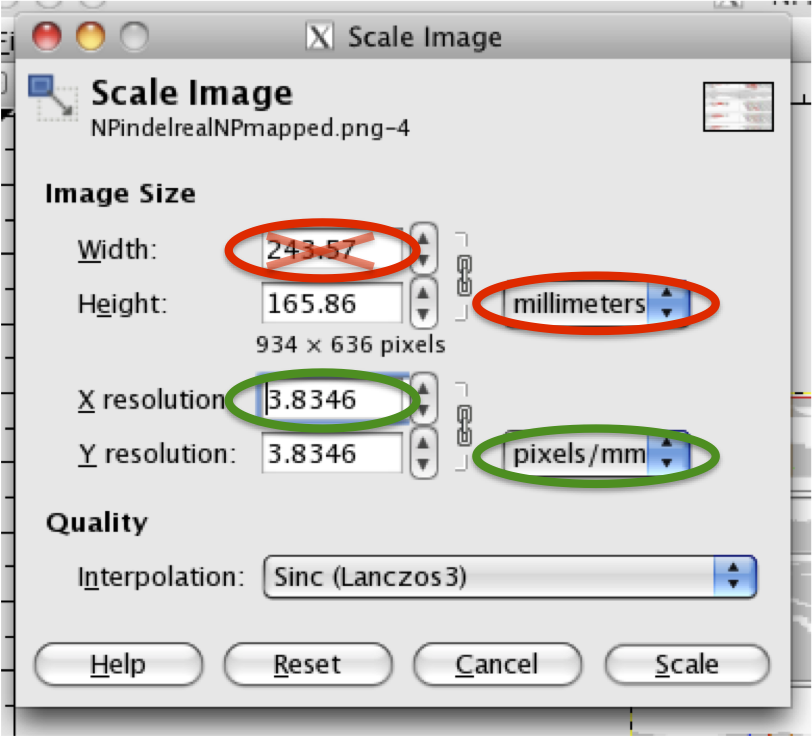
3.Resize the image: Under the Image menu choose Scale Image (see screenshot below).  In the pull down menu next to Height (RR: red oval on right), set the units of measurement,to millimeters. If the Width is over 173.5mm, type 173.5 in the Width box (RR: red oval with an X in it) (17.35cm is our maximum allowable width for figures) and hit Tab. The new Height of the figure will appear, scaled proportionately to the change in Width. The Width cannot be below 83.0mm, and the height cannot be more than 233.5mm. If the Height and Width are within these prescribed limits, no adjustment to your figure size needs to be made. 
4. From the File menu: choose Save As. Click the + sign next to "Select File Type (By Extension)". From the menu that appears, select TIFF. Click Save. Set Compression set to LZW. If you're prompted about layers in the file, select Flatten Image.

But it doesn't work!

THE PROBLEM:

Step 3 of the recommended process above tries to shrink the image by adjusting its size in mm to below 173.5.  Resizing this way massively downgrades image quality.  

THE IMMEDIATE SOLUTION:

The work-around is to use the lower set of controls to  increase pixels/mm instead of decreasing mm.  This causes a correlated change in the size of the images, so doesn't degrade image quality. 

First do use the upper drop-down menu to set the image size units to millimeters as instructed above (red oval on right).  Don't change the numbers in the box in the other red oval.

Instead use the lower drop-down menu to change the resolution units to pixels/mm (green oval on the right), and use the box beside it (other green oval) to increase pixels/mm until the image size (in the other red oval) falls to ≤173.5 mm.  

A DESIRABLE LONG-TERM SOLUTION:

This ought to be fixed in PLoS's instructions to authors, so that people can use open-source software to get their images to PLoS's specifications.

New paper on Neisseria DNA uptake specificity

ResearchGate (which I generally ignore) has pointed me to what looks like an excellent paper on DNA uptake specificity in the various Neisseria species.

It's titled "Dialects of the DNA Uptake Sequence in Neisseriaceae" by Stephan A. Frye, Mariann Nilsen, Tone Tønjum, and Ole Herman Ambur.  It's open access in PLOS Genetics; you can read it here.

No, I haven't had time to properly read it myself yet.)
Another two-month gap - I really don't know why I haven't been blogging. (Probably something to do with the massive preparations for my online Useful Genetics course at Coursera (RRTeaching update here).

The RA has done a fabulous job on her purine-regulation paper.  She designed and carried out the experiments and wrote the paper with only minimal input from me, sent it first to Nucleic Acids Research, and when they bounced it back sent it right off to Molecular Microbiology.  They provisionally accepted it, with only minor revisions (no new experiments), and she sent the revised version back to them within a few days.

Our NSERC grant proposal was successful, which is nice.  It wasn't rated very high so we have only a small amount of money, but it's for five years.  We still have quite a bit of money from our former CIHR grant (continuing under an automatic no-cost extension) so even if my next CIHR proposal fails we'll still have money to run the lab and support at least one grad student.  The RA will be leaving us soon, but fortunately for everyone she has a great new position in the new building across the street.

For this next CIHR proposal (due Sept. 15) I'm going to go back to our strength in regulation. Several areas need to be investigated.  One is the purine regulation - the RA made a start into probing the biochemistry, but this needs to be taken further.  She's also getting some new results on how CRP and Sxy interact.  And there's the long-standing puzzle of how mutations in murE hyper-activate the competence regulon.

Ending the long gap (the RA's purine-regulation manuscript)

Aarrghhh!  So long since I've posted any science here (or for that matter any teaching on RRTeaching).    This short post is just to get me going again...

The Research Associate recently gave me a new version of her manuscript on how purine nucleotides regulate the development of natural competence, and we just finished discussing how the various pieces of information should be organized.  She starts with the evidence that disproves my once-favourite hypothesis that competence genes are repressed by the purine repressor PurR.  She then presents new evidence that providing cells with a purine nucleotide (AMP or GMP) reduces competence by reducing the translation (but not transcription) of the sxy gene.

Sxy activates competence genes by working in concert with the activator protein CRP.  Its translation is known to be limited by a base-paired stem in sxy mRNA, and the RA has now shown that mutations that weaken this stem also make cells immune to the effects of added AMP or GMP.

How might this work?  She's able to rule out two hypotheses - that the sxy mRNA stem functions as a purine-sensitive riboswitch, and that the AMP/GMP effect involves an Hfq-dependent small RNA.  She also shows that induction of competence is influenced by intracellular purine pools, because it is reduced when the purine biosynthesis pathway is constitutively activated by a purR knockout.  The effect of constitutive purine synthesis must be due to purine nucleotides and not biosynthetic intermediates, because normal competence is restored when the last step in nucleotide biosynthesis is knocked out by a purH mutation.

(Hmmm, this makes more sense now than it did in our discussion.  More evidence that writing blog posts helps me think clearly.)

Estimates of fraction competent aren't very reliable

I repeated the fraction-competent assay on log-phase murE749 hypercompetent cells, as I said I should in the previous post.  I did a very thorough and well-controlled experiment, but the results tell me that this isn't a very reliable measure of how much the cells in the culture differ in their competence.

I grew the cells at low density in rich medium for about 3.5 hours, so they would all be growing exponentially (in log phase).  I added MAP7 DNA to the cells, let them grow for 15 minutes, and added DNase I to prevent continuing DNA uptake.  I then let the cells continue growing for another  1.5 hours, to allow all the antibiotic resistance alleles to be fully expressed.  Then  I diluted the culture and spread the cells on agar plates containing different antibiotics, singly or in pairwise combinations.

MAP7 DNA contains point mutations causing resistance to 7 different antibiotics, but I only selected for 4 of them in this experiment: novobiocin (nov), kanamycin (kan), spectinomycin (spc) and nalidixic acid (nal).  The nov and kan alleles are close together on the chromosome, so I didn't select for those two together, but I selected for nov+spc, noc+nal, nal+spc, kan+nal, and kan+spc.  These combinations gave me 5 different measures of fraction competent.

The nal allele gave a low transformation frequency on its own (4.9x10^-4), and all 3 of the combinations that included nal gave low estimates of fraction competent: 0.06, 0.08 and 0.09.  The other two combinations gave higher estimates: 0.28 and 0.58.

That's a ten-fold range of the estimates.  Practically, the difference between 0.06 of the cells being competent and 0,58 being competent is enormous, but the fraction competent assays can't tell the difference.

A former student had proposed developing a fluorescent reporter-gene assay that would let us look at cells under the microscope and count the ones that had turned on their competence genes.  I still think it would be a big pain, largely because the cells are so small, but maybe the recent improvements in reporter molecules and in microscopy now make this a good idea.

inconclusive fraction-competent results

A few posts ago I described surprising results from an experiment measuring the fractions of the cells in different cultures that were competent.  Here they are again:


And here are the new results:


Conditions were a bit different this time.  First, the KW20 (wildtype) culture had not been induced to maximum competence this time - these cells were approaching stationary phase and are 50-100-times less comepetent.  Second, this time I remembered to give all the cultures 60 minutes in rich medium before plating to allow expression fo the spectinomycin resistance.

Including expression time doesn't appear to have significantly changes the transformation frequencies for SpcR selected alone, but it substantially increased the double transformation frequencies (NovR SpcR), and this reduced the apparent fraction competent to below 1.0.

So this new experiment clarifies why I got the anomalously high FC in the previous experiment.  Unfortunately it doesn't address the reason I wanted to measure FC in the hypercompetent mutants in the first place.  The question arose from the analysis of the ∆HI0659 mutant's growth rates.  In this experiment). I had found that cells carrying the HI0659 mutant grew normally.

I did this experiment because I wanted to find out whether unopposed expression of the HI0660 'toxin' harms cells (killing them or inhibiting their growth).  In the ∆HI0659 cells the HI0660 'toxin' is induced but not opposed by the HI0659 'antitoxin' when competence genes are on.  Because competence genes aren't normally on in growing cells anyway, I had tested growth in two hypercompetent mutant backgrounds, sxy-1 and murE749 - this was normal too.

The fraction competent experiments were intended to test whether most of the cells in the hypercompetent cultures has their competence genes on - if not then we might not see a dramatic growth difference even if the toxin does harm cells.  But I foolishly did them with cells approaching stationary phase, when I should have done them with cells in exponential growth.  I don't need to bother doing this for the sxy-1 mutant, since I already know that only a small fraction of its cells are competent then (I did this experiment years ago), but I should test it for murE749.

hfq knockout results

I've now examined the effects of knocking out the small RNA-regulating protein Hfq under a wide range of conditions, testing our hypothesis that it regulates competence by helping unfold the translation-inhibiting stem of sxy mRNA.

In my previous experiment I found that the hfq knockout (∆hfq) causes a ten-fold decrease in transformation, both during growth in rich medium and after transfer to the starvation medium MIV.  This time I also tested the mutation in combination with either of two hypercompetence-causing mutations (sxy-1 and murE749), and under culture conditions.  The reasoning was that if ∆hfq's transformation defect is due to a defect in sxy translation, it should be reduced or eliminated by the sxy-1 mutation, which we know destabilizes the RNA stem.  Seeing a similar effect of the murE749 mutation might suggest that this mutation also acts by destabilizing an RNA pairing structure, perhaps the same sxy mRNA stem.

Here are the results.

 Starting from the bottom up:  In the competence-inducing medium MIV we see the same ~10-fold defect in the wildtype background but no defect in the sxy-1 or murE749 backgrounds.  This supports the above hypothesis and suggests that the murE749 mutation also acts by disrupting RNA pairing.

We think that transfer to MIV medium causes two events that together cause expression of the competence genes: (i) cAMP levels go up, and (ii) the mRNA stem no longer blocks translation of sxy mRNA into Sxy protein.  Simply adding cAMP to log-phase cells induces only a low level of competence, since the mRNA stem continues to block its translation.  This predicts that adding cAMP to hfq mutants will give 10-fold lower competence, but instead we see that competence is nearly normal in the wildtype background and fully normal in the sxy-1 or murE749 backgrounds.  This suggests that ∆hfq's competence defect is not duo to a defect in destabilizing the sxy mRNA stem, but instead to an effect on intracellular cAMP levels.

In late-log cells (in rich medium) we think that the low-level competence normally observed is due to a spontaneous increase in cAMP levels, not to destabilization of the sxy mRNA stem.  But the experiment saw a larger-than-expected defect in the wildtype background, a ~10-fold defect in the sxy-1 background, and no defect in the murE749 background.  I don't know what to make of this.

The final condition was 'overnight cultures' - cultures that grew to maximum density and remained at 37°C on the roller wheel until morning.  The hfq+ and ∆hfq cultures in the wildtype background gave no transformants at all, but both hypercompetent backgrounds showed much stronger competence defects than under other conditions (>100-fold).  However this could be an artefact of the cessation of growth on expression of the novobiocin resistance allele.

Overall, what should we conclude?  I find the cAMP results to be the most compelling; they strongly suggest that our hypothesis is wrong; Hfq does not contribute to the translatability of sxy mRNA.

Choosing a journal for your manuscript

Listening to Bruce Dancik's #CSPPubTour12 talk yesterday about choosing a journal and submitting your manuscript got me thinking about issues he didn't emphasize.  I started with a few, but my list keeps getting longer and longer:

Likelihood of acceptance:  Do your subject, approach and results fit the mandate of the journal (is yours the kind of manuscript they’re looking for)?

Prestige for your CV:  How good is the journal's reputation?  How high is its impact factor?

Prestige for journalists:  Are papers from this journal often reported in the mainstream media?

Readership:  Does the journal cover a specialized topic or a broad area of science?  Which kind of audience are you writing for?

Ease of finding for readers:  Is the journal indexed by everything?  How well can you use keywords in the title and abstract to bring in readers from Google Scholar and other search engines?

Access to your article:  Does the journal provide immediate open access for all its papers?  Is this an option, for an extra charge?  Open access after 6 months or a year?  Subscription only?  If subscription access, how widely is it subscribed to?

Cost of publishing:  Are there page charges?  Optional or required publication charges for open access?  Charges for colour figures (only an issue for print journals)?

Limits on article length:  No limit?  Very tight?  Charges for extra pages?

Online supplementary materials:  Does the journal host these?  What are the limitations?

Copyright and licensing:  Must you sign away your rights?  Can others reuse your material (e.g. use your figures in teaching)?

Turnaround time:  Rapid pre-screening?  Total time from submission to publication?  Online early access?

Is this an ethical publisher?  Elsevier?  Other for-profit?  Society journal?  Predatory publisher (see Beall's list)?

Type of publication:  Online-only?  Print edition only?  Both?

Tiresomeness of Instructions to Authors:  Will getting your figures into the obscure required format force you to spend $500 on the full version of Photoshop?

Might the journal highlight your paper?  Does it include a News and Views or other section that highlights some papers in each issue?

Relative activities of comM from strains Rd and NP

A month or so ago I described four experiments I wanted to do.  I've now done the last of them, testing whether the comM gene of strain NP could be partly responsible for that strain's 100-fold lower transformability.

...and the answer appears to be...  NO  (with one qualification).

The experiment was to compare the abilities of plasmid-borne Rd and NP comM genes to restore full competence to Rd cells whose chromosomal comM gene had been deleted.  The RA made all the strains for me - all I had to do was measure their transformation frequencies after fully inducing competence by transfer to starvation medium.  The first four bars in the graph below show the results:


Both comM alleles restore normal competence to the Rd knockout when cloned in the forward orientation but not when cloned in the reverse orientation.  I think each insert has its own CRP-S promoter, but the plasmid also carries the E. coli lacZ promoter which, I suspect, interferes with expression of inserts whose promoters face in the reverse orientation.

The motivation behind this experiment was a recombinant strain identified by an undergraduate who was working with the postdoc.  This strain transforms only 10% as well as Rd; it has been sequenced and we know it contains a single 40 kb segment of NP sequence.  The only known competence gene in this 40 kb segment is comM, so they hypothesized that a partially defective NP comM might be responsible for the recombinant's 10-fold reduced competence and partly responsible for NP's 100-fold lower competence.  This new result suggests that this hypothesis is wrong.

The qualification is that strong expression from a plasmid could mask lower expression or catalytic activity of NP's comM gene.  The gold standard experiment would be to replace the Rd chromosomal allele with the NP version and vice versa.  For various technical reasons we haven't been able to do this yet.

A rotation student replaced the recombinants NP comM allele with the knocked-out Rd version - this reduced its transformation frequency by another 10-fold, about the same as the TF of a simple RD ∆comM strain.

I had tried to transform a ∆comM strain of NP with the Rd comM allele, but the ∆comM mutant the RA made was, unexpectedly, completely non-transformable.  She has now given me another NP ∆comM isolate to test.  That's the last column in the chart; the red star indicates no transformant colonies at all, so this isolate too is completely non-transformable.  This result is consistent with the similarity of the Rd and NP comM plasmid results; they both suggest that the NP comM gene is fully functional, and that some other difference(s) must be responsible for its lower transformability.

So why does the recombinant have lower transformability?  Before designing any more experiments I need to be better able to think about the relative chromosomal locations of the various selectable markers and competence genes we're interested in.  To this end I'm having our work-study student take a break from glassware-washing and media preparation to do what she calls an 'arts and crafts' project - making us a poster showing the locations of all these genes drawn on a circular chromosome.  I  just need to give her a list of the genes/ locations to include on her poster.

He takes after me!

Here's a photo of my nephew's science project.  He represented the features of the eukaryote cell using cake and candy.  The nucleus is a peanut-butter cup, with a jaw-breaker nucleolus.  He got a mark of 100%.


A new twist on the fraction-competent problem

On Sunday I attempted to measure what fraction of the cells in some cultures were competent (able to take up DNA fragments and recombine them into their chromosome).  I've previously written about this kind of analysis here and here.

Usually when I do this kind of experiment I find that only some cells were competent (anywhere from about 10% to about 50%).  But this time I got a very different result, and I don't know why.

I was testing three strains - wildtype cells (strain KW20) and two hypercompetent mutant derivatives, carrying the sxy1 and murE749 mutations.  Both KW20 and sxy1 have been tested several times before; mutrE749 hasn't.

The procedure is simple.  Transform cells with MAP7 chromosomal DNA and select for two antibiotic resistance mutations located far apart on the chromosome (so they won't ever be carried on the same DNA fragment).  Select for each resistance separately and for the two together (double-transformants).  Count the resulting colonies and calculate the transformation frequency for each resistance separately and for the double-transformants.

Calculate the fraction competent as the product of the two single-mutation transformation frequencies divided by the double-transformant frequency and by a fudge factor somewhere between 2 and 4.

The fudge factor incorporates two sub-factors accounting for different effects.  The first effect is the chance that a single cell took up and recombined two DNA fragments, each containing one of the mutations, but that the incoming DNAs recombined with different strands so that, when the cell divided, one daughter cell got one mutation and the other got the other.  This factor is complicated by the unknown effects of mismatch repair, but on average 2 is the appropriate value. The second effect is whether the cells did any cell divisions before they were placed on the agar to grow into colonies.  If they did, then cells transformed by a single mutation will have given rise to one resistant colony and one sensitive colony.  This factor should  have a value of 2 if all the cells had time to divide before plating (if, for example, they needed time to express the antibiotic resistance), by less than 2 if only some did, and by 1 if the cells were plated immediately after transformation.  In my experiment I didn't allow any expression time* so this second factor should be closer to 1 than 2.  For simplicity I'll use a complete fudge factor of 3.

* In retrospect I should have allowed expression time, because one of the markers I was selecting for is spectinomycin resistance, which we think of as needing an hour's expression time.  But I forgot and, rather surprisingly, still got tons of transformants.

Here are the calculations:


What's wrong with these nice numbers?  The fraction competent should ALWAYS be less than 1; that's why it's called a fraction!

Might my assumptions be invalid?  This analysis requires that cells be able to take up more than one fragment of DNA, and that taking up one fragment does not affect the probability of taking up another fragment.  Because previous experiments have always given values less than 1, we've been assuming that this requirement is met.  But this new result only makes sense if many of the cells could only take up one fragment of DNA.

Might my DNA or plates be faulty?  The problem isn't due to using some new DNA prep with different properties; I used a fresh tube of the same MAP7 DNA stock we've been using for years.  Could it be because I forgot to give the cells some expression time after DNA uptake?  Might the lack of expression time reduced the numbers of double transformants (SpcR NovR) much more than it reduced the numbers of single SpcR transformants?  But lack of expression time doesn't appear to have been a problem, since I got at least as many SpcR transformants as NovR transformants.  The DNase I stock could be a problem.  The transformation reactions are stopped after 15 minutes by adding DNase I to degrade the remaining DNA - a few days ago I tested the DNase I stock, by adding it to the DNA 5 minutes before I added the cells, and found that it wasn't very effective - the residual transformation frequency was still quite high.  This means that some cells might have taken up DNA while they were on the plate, but since this would only exacerbate the expression-time problem it shouldn't have been a big factor.

I only did this experiment because it would help us interpret the lack of effect of the HI0659 knockout on growth rates (in the experiment I described yesterday).  If most cells weren't competent even in the hypercompetence mutants, then not seeing a growth defect in the culture doesn't meen that the competent cells didn't experience a growth defect.  But this weird result means I need to do more experiments to figure out the reason for the discrepancy with previous results.


the HI0660 'toxin' doesn't affect cell growth or survival

My last experiment showed that HI0660 encodes a 'toxin' of some sort, which prevents transformation when induced in the absence of the antitoxin encoded by HI0659.  So yesterday I did detailed growth curves for cultures carrying the HI0659 knockout and either of our hypercompetence mutations.

The logic is that neither HI0660 or HI0659 will be expressed during growth in wildtype cultures, because the competence genes are not induced then.  They're weakly induced at the end of growth, but strongly induced only when cells are starved or in the presence of the hypercompetence mutations.   This means that, if HI0660 does kill cells or prevent growth, this effect will best be seen in the presence of the hypercompetence mutations.

The results show no evidence of significant growth or survival differences due to unopposed expression of HI0660.  Each line in the two graphs below shows the mean for 7 replicate wells of the same inoculum.  The upper graph used inocula that were of single small colonies diluted into 10 ml medium. The lower graph used inocula that were 1/1000 dilutions of overnight cultures into medium.

This is an interesting result, because it suggests that HI0660 acts directly on DNA uptake, not by killing cells or interfering with their growth.  Because homologs of HI0660 are known to act by inactivating specific mRNAs, we may have to use RNA-seq to identify its mode of action.


Woo-hoo!! A hypothesis proved correct!

Last spring I came up with a far-fetched hypothesis to explain the phenotypes of two of our competence-gene knockouts,HI0569 (competence eliminated) and HI0660 (normal competence).  I proposed that HI0660n encoded a 'toxin' that prevents competence or kills cells expressing it, and that HI0659 encodes an antitoxin that protects cells from the actions of HI0660.  You can read all about it here.

Yesterday I finally was able to do the critical experiment, testing the competence phenotype of cells with both genes knocked out.  It's normal!

And here's the data:


The asterisk on the HI0659 column indicates that this is a 'less than' data point, since there were no transformant colonies on any of the plates.

This result confirms that HI0660 does something that COMPLETELY prevents transformation, and that HI0659's job is to prevent HI0660 from doing whatever it does.


hfq results

Yes indeed, hfq is needed for full competence development.  The mutant grows as well as its wild-type parent (top graph) but develops about ten-fold lower competence (lower graph).


Next step:  Make DNA from the mutant and use it to transform the hfq knockout into the hypercompetent mutants.  Then I'll test the effect of the hfq knockout on their competence.  If Hfq avcts directly on the sxy mRNA stem that regulates translation, I expect the mutants to be unaffected by loss of Hfq because their translation is not limited by the stem.  

As a check that Hfq's effects aren't due to indirect effects on cAMP levels or CRP activity, I'll also test the effect of the knockout in wildtype and hypercompetent cells with added cAMP.

What about effects on the murE hypercompetence mutants?  I'll test that, but I'm not sure how to interpret different results...